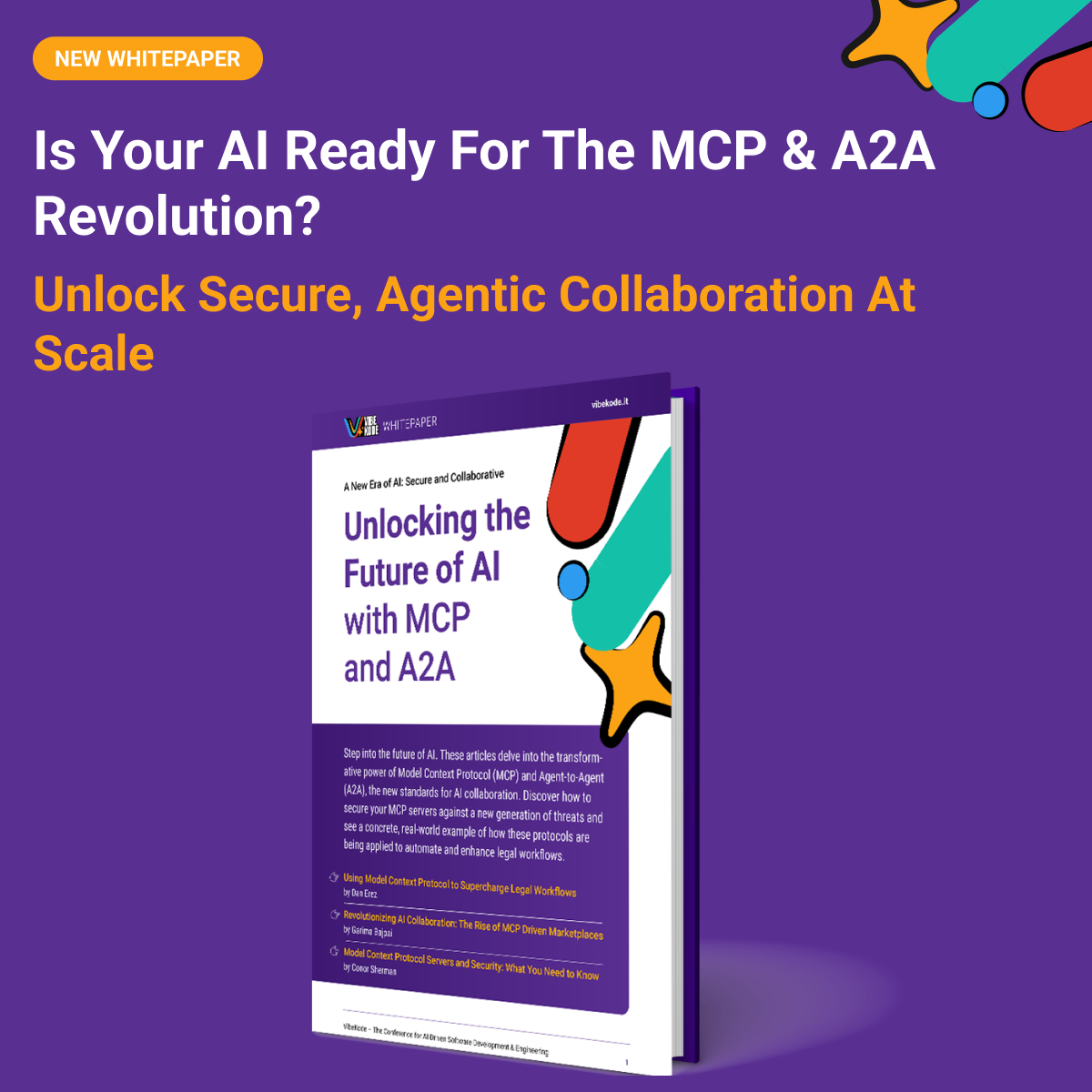



That choreography is still rare, but in 2025 it finally feels within reach because the industry is rallying around a new wiring standard called the Model Context Protocol (MCP). MCP provides a universal handshake that lets any AI agent advertise what it can do, discover what others can do, and stream precisely the context each step requires.
Lets unpack why interoperability has held agents back, how MCP fixes the plumbing, and why Microsoft’s embrace of the protocol may accelerate an era of truly cooperative AI.
Understanding AI Agents and the Interoperability Gap
AI agents aren’t merely smarter chatbots. They perceive their environment, break an objective into smaller goals, choose the best tool for each step, and learn from the outcome so the next attempt is better. GitHub’s new Agent Mode in Visual Studio Code is a case in point: it refactors multi-file codebases, issues terminal commands, and patches runtime errors until tests pass—often without another engineer touching a keyboard.
Yet, autonomy creates a new problem: isolation. Enterprises already deploy multiple brand-specific agents, think Claude for coding, Gemini for analytics, and ChatGPT for customer support. Each is effective in its own sandbox, yet, blind to the others’ memories. This means end users juggle three conversations instead of one, while institutional knowledge fragments.
It’s estimated that 85% of enterprises will operate more than one agent this year, but with nothing like the inter-agent coherence we expect from human teams.
Traditional REST or GraphQL APIs were meant to be glue, but they assume the user knows the exact endpoint and schema. Agents, by contrast, can explore the tools they can access and find resources that can sharpen their reasoning. What if those tools were other AI agents?
Sign Up for Our Newsletter
Stay Tuned & Learn more about VibeKode:
Model Context Protocol: A Universal Language for Agents
MCPs were introduced last year and have been refined since then, and they represent a radical step forward in the potential capabilities of AI agents.
Think of MCP as a universal language for AI cognition. An application can attach itself as an MCP server advertising three things:
- Tools it can execute (for example, create_invoice or run_sql_query).
- Read-only resources it can share (say, a PDF or a database schema).
- Reusable prompt templates.
An MCP client, typically the AI agent, starts by asking the server what capabilities exist, then decides which to invoke as reasoning unfolds. Discovery is baked in, so a client that meets a new server at runtime adapts automatically. Connect a Sentry MCP server to an incident-management agent and, with no new code, that agent learns it can pull stack traces and link them to remediation steps.
Want to make a change? Replace Sentry with Datadog, and the conversation pattern hardly changes, as it can follow the same learning patterns as its alternative.
Another breakthrough is Context Protocols. MCP messages can carry arbitrary chunks of text or embeddings, so an agent can request ‘customer 12345’s order notes’ and receive only the paragraphs its model can digest, trimming token costs while protecting privacy. Where REST asks, ‘What function do you want to run?’, MCP first asks, ‘What do you already know, and what extra context will sharpen your reasoning?’.
An AI agent automating cloud optimization could communicate with other agents to prioritise resource deployments, making things much more efficient. It will be able to go much deeper than just tracking and optimizing around historic usage, and identifying ‘peak times’, it will understand the context of what deadlines and projects are high priority, and allocate resources based on that context.
Microsoft’s Bold Bet on MCP
Microsoft detected the MCP upside early on. They’ve partnered with Anthropic to release an official C# SDK, letting any .NET service become an MCP server or client with a few annotations. GitHub has now rolled MCP into Agent Mode for every Visual Studio Code user, instantly opening a marketplace of servers, from Playwright for browser automation to Notion for documentation, in one update.
MCP Everywhere in Copilot Studio
MCP has been declared generally available inside Copilot Studio, Microsoft’s low-code canvas for business agents. Makers can now drag an MCP connector onto the canvas, point it at an Azure API Management gateway, and grant an AI agent controlled access to any tool the organisation has registered, with Azure API Center acting as a private catalogue of trusted servers.
Multi-Agent Orchestration
Most eye-catching, though, was multi-agent orchestration. Instead of scripting a single super-Copilot, builders can link specialised agents, like sales, legal, and DevOps, so they delegate tasks to one another. A Copilot Studio agent might pull CRM data, hand it to a Microsoft 365 agent to draft a Word proposal, then trigger another agent to schedule Outlook follow-ups, all without human nudging.
A Converging Protocol Landscape
Interoperability isn’t a Microsoft-only crusade. Google has unveiled the open Agent-to-Agent (A2A) protocol aimed at secure information exchange between agents, signalling that the majors prefer convergence over yet another standards war. Microsoft promptly added A2A bridging in Copilot Studio for agents that already speak MCP, betting on a layered approach akin to the web’s TCP/IP stack.
Tooling and Runtime Support
Support is rippling outward. Visual Studio, JetBrains IDEs, and Eclipse now auto-discover local MCP servers, while Windows maintains a per-machine registry so desktop apps can publish capabilities without magic ports. Azure AI Foundry rounded things off by exposing an MCP endpoint for every model it hosts, meaning a freshly fine-tuned proprietary model can drop into agent workflows with no glue code.
Towards Truly Cooperative Agents
Once agents share a protocol, new patterns emerge. A travel-booking agent can store your seat preference and hand it to a finance agent reconciling expenses, no fragile database sync required. Agents wired together can open tickets, fetch logs, and suggest patches inside the same Slack thread, turning multi-step incidents into single conversations.
There’s a clear appetite for this level of interoperability, as protocol-level interoperability could be the top enabler for scaling agentic AI. A bank would be far more willing to let a Gemini-powered compliance agent vet loan documents when it can rely on an MCP handshake to fetch them from a GPT-powered classifier, with OAuth scopes and audit trails enforced end-to-end.
The ‘Internet of Agents’ Vision
There’s a lot of chatter about how MCP could enable an ‘Internet of Agents’. Just as HTTP, TCP, and DNS let millions of web servers cooperate without sharing code, MCP (plus A2A) could let agents publish their tool catalogues and subscribe to others’. A personal health agent might grant a nutrition agent read-only access to biometric data and, in return, call its meal-planning tool. Capability scopes embedded in MCP metadata would lock the contract, and either agent could be swapped out without rewriting the rest of the system
For developers, the payoff is simplicity. Instead of importing SDKs for Salesforce, ServiceNow, and Confluence, they register those systems as MCP servers. At reasoning time, the agent decides which tool to call, and when a new SaaS vendor ships an MCP server, integration is instantaneous. Software begins to resemble a colony of cooperating experts rather than a brittle monolith of APIs.
Sign Up for Our Newsletter
Stay Tuned & Learn more about VibeKode:
Conclusion
The Model Context Protocol tackles a deceptively mundane yet existential question: how can thinking machines share what they know? MCP frees agents from their silos without forcing developers to rewrite the internet.
If the vision holds, tomorrow’s users will no longer pick an ‘OpenAI agent’ or a ‘Google agent.’ They will state a goal, and a chorus of cooperative agents will decide, negotiate, and execute behind the scenes. The real question may no longer be whether MCP can enable truly cooperative agents, but what new kinds of work and creativity will emerge once the walls between AI agents finally fall.
Author
🔍 Frequently Asked Questions (FAQ)
1. What is the Model Context Protocol (MCP)?
The Model Context Protocol (MCP) is a standardized interface that enables AI agents to share context, tools, and capabilities in a structured way. It allows different systems to interoperate without tight coupling. This makes it easier to build scalable and modular AI architectures.
2. Why is MCP important for multi-agent orchestration?
MCP provides a common protocol for coordinating multiple AI agents. It ensures consistent context sharing and communication between agents. This reduces complexity and enables more reliable orchestration across distributed systems.
3. How does MCP improve AI agent collaboration?
MCP enables agents to access shared context and tools dynamically. This allows agents to collaborate more effectively without needing hardcoded integrations. As a result, workflows become more flexible and adaptive.
4. What problems does MCP solve in AI systems?
MCP addresses issues like fragmented context, brittle integrations, and lack of interoperability. It standardizes how agents exchange information and invoke tools. This leads to more maintainable and extensible AI systems.
5. How does MCP relate to tool usage in AI agents?
MCP defines how tools are exposed and accessed within an AI ecosystem. Agents can discover and use tools through a consistent interface. This simplifies tool integration and reuse across different agents.
6. Can MCP be used across different AI frameworks?
Yes, MCP is designed to be framework-agnostic. It enables interoperability between different AI systems and vendors. This allows organizations to avoid vendor lock-in and build more flexible architectures.
7. What role does context play in MCP?
Context is central to MCP, as it defines the shared state between agents. MCP ensures that context is structured, portable, and accessible. This improves decision-making and coordination among agents.
8. How does MCP support scalable AI architectures?
MCP decouples agents from each other and from specific tools. This allows systems to scale by adding new agents or capabilities without breaking existing integrations. It supports modular and distributed AI system design.
9. Is MCP relevant for enterprise AI systems?
Yes, MCP is particularly valuable in enterprise environments where multiple AI agents and systems must work together. It improves governance, interoperability, and scalability. This makes it suitable for complex production use cases.
10. How does MCP differ from traditional API-based integration?
Unlike traditional APIs, MCP focuses on structured context exchange rather than isolated requests. It enables continuous interaction between agents. This results in more dynamic and intelligent system behavior.