


Vibe coding, the use of AI-assisted natural language prompts to generate software has accelerated the pace of development across industries. Yet executives face a defining question: is this surge in “vibe mastery” real transformation or a convenient myth?
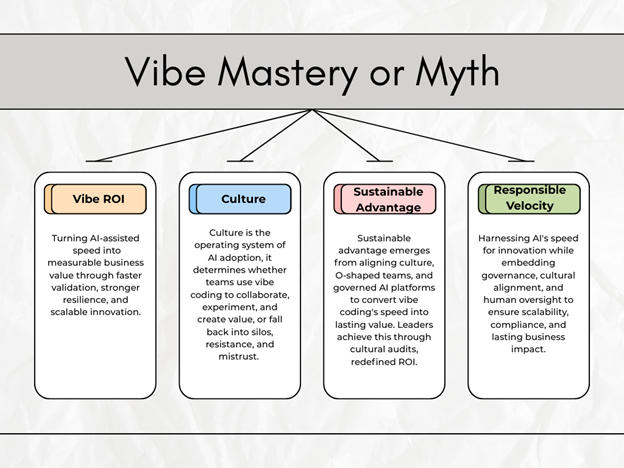
Fig. 1: Vibe Mastery or Myth
Culture, Teams, Tools for Executive ROI
AI has changed software creation from a mechanical act of coding syntax to a creative act of directing intelligence. “Vibe coding”, the ability to build applications through natural language or example-driven intent represents both a breakthrough and a burden.
For executives, it offers promises of speed, talent expansion, and competitive advantage. Yet alongside every acceleration comes the same strategic paradox: speed without governance isn’t innovation it’s entropy. The leaders who gain from vibe coding will be those who treat it as more than a “developer productivity boost.” The mythology creeps in when leaders equate these micro-efficiencies with macro-ROI. Faster code does not automatically mean faster business value. Without rethinking culture, talent models, and governance boundaries, organizations risk confusing motion for progress. They will see it as a cultural operating model transformation.
Across technology ecosystems, vibe coding has begun to deliver measurable business impact, redefining how innovation scales. Prototyping cycles once measured in weeks are now compressed into hours, accelerating time to market and decision velocity. Product experimentation has expanded beyond technical contributors, empowering non-technical innovators to participate directly in solution design. Meanwhile, knowledge workers are deploying AI copilots to operationalize domain logic, streamline testing, and elevate analytics, creating new efficiencies and unlocking competitive advantage across the enterprise.
Sign Up for Our Newsletter
Stay Tuned & Learn more about VibeKode:
Mastery or Myth: Understanding True “Vibe ROI”
Executives often ask, “How do we measure the ROI of AI-driven development?” The mistake is expecting traditional metrics velocity, lines of code, or sprint throughput to explain transformative value. True “Vibe ROI” emerges when an organization can turn ideas into impact faster than its competitors, closing the gap between innovation and execution. It also depends on eliminating cognitive and collaboration friction so teams across functions can create and adapt seamlessly. Ultimately, it is built by developing defensible differentiation through flexible, AI-driven platforms that evolve with the business.
Industry data shows that firms with structured AI adoption programs achieve roughly 2x scaling velocity compared to teams experimenting in isolation. This suggests mastery lies not in the tools themselves, but in how leadership designs systems enabling meaningful scaling. For leaders, the central question becomes: Can vibe mastery generate lasting advantage, or will it flatten into another productivity myth?
Culture: The Real Operating System of Vibe Mastery
Transformation begins not in the technology stack, but in the culture that governs it. Traditional organizations grew around functional silos engineering here, operations there, business units over there. Vibe coding collapses those walls. The same AI tools that empower developers also democratize creation across roles designers, marketers, analysts who can now generate functioning prototypes with minimal handoffs.
Yet cultural inertia remains the silent killer of AI ROI. Organizational DNA still encodes patterns of control, code reviews, architecture boards, procurement gates, release cadences. For AI-driven development to thrive, those controls must evolve from command models into trust-and-verify ecosystems.
Three key shifts define cultural mastery in this space:
- From code ownership to value stewardship. Roles shift from “who writes the code” to “who ensures it delivers business value.” AI copilots augment coding, but human oversight steers intent alignment, risk evaluation, and revenue pathways.
- From risk aversion to experimentation with governance. Governance doesn’t vanish, it’s refactored. Instead of bottleneck approvals, organizations embed real-time guardrails through ethical AI frameworks, IP protection, responsible licensing, prompt governance, and platform-based compliance automation.
- From productivity pride to outcome obsession. Speed metrics excite practitioners, but executives must redirect attention toward business outcomes: reduced time-to-market, improved customer conversions, or cost-to-serve efficiency.
Redefining Teams: From Developers to Direction Designers
Team structure is where vibe coding either scales or stalls. Historically, software delivery followed T-shaped teams, deep technical specializations connected through agile collaboration. Vibe coding now invites a more adaptive shape: O-shaped teams, open loops where domain experts, AI agents, and developers co-create continuously. By redesigning teams around AI orchestration rather than pure function, organizations gain both velocity and verifiability. McKinsey’s 2025 AI adoption survey reinforces this point: companies integrating cross-functional AI orchestration roles achieved a 38% improvement in product scaling reliability versus single-discipline teams.
Thus, vibe mastery becomes less about replacing developers and more about redefining collaboration boundaries where humans manage direction, not just production.
The New Tool Stack: Governance Is the Competitive Edge
For many executives, the instinct is to chase the latest generative AI platform. Yet the competitive advantage will not come from having the flashiest model but from constructing governed platforms for composable innovation.
Governed AI development platforms are emerging as strategic enablers of responsible innovation, combining permission-aware data environments with version-controlled prompt libraries to ensure traceability and compliance. They integrate AI agent orchestration frameworks that enhance transparency and explainability, while embedding robust controls for bias detection, security assurance, and intellectual property monitoring. Together, these capabilities establish a foundation for scalable, trustworthy AI across enterprise ecosystems.
Consider banking, where generative AI code assistance could touch regulated logic. Without strict lineage tracking of AI-generated components, compliance exposure skyrockets. Forward-thinking banks now integrate “AI bills of materials” (AI-BOMs) documenting model versions, prompt sources, and human signoffs transforming governance from paperwork into an integral design discipline.
Executives evaluating ROI must account for these tool-layer decisions. The investment in governance platforms yields compound returns in risk mitigation, audit readiness, and developer trust especially as regulatory landscapes tighten globally.
Metrics That Matter: Rethinking ROI in the Vibe Era
Traditional development KPIs no longer capture success. Lines of code, sprint velocity, or backlog burndown fail to reflect value creation when AI generates most artifacts. Instead, next-generation ROI frameworks emphasize:
- Cycle Clarity: How quickly can a validated idea reach a live experiment?
- Retained Advantage: Are we building reusable IP or temporary prototypes?
- Controlled Efficiency: How much human oversight is optimized, not eliminated in delivery?
- Risk Resilience: Can the organization detect and correct AI-driven errors before they scale systemically?
A leading manufacturing firm restructured its development ROI dashboard around three executive-level metrics: time-to-validation, percentage of reusable assets, and AI trust index. Within six months, they achieved an 82% improvement in prototype reuse and a measurable increase in solution reliability. This approach illustrates a broader principle: executives gain cultural and financial returns when they measure what creates durable advantage, not what creates temporary optics.
Executive Strategies for Sustainable Advantage
So, what does leadership mastery look like in this new terrain? It demands convergence, the deliberate unity of cultural intelligence, operational design, and technological stewardship. Leaders must cultivate organizations that are both adaptive and principled, where innovation advances without compromising trust or accountability. Sustainable advantage now depends on integrating human and machine intelligence into cohesive systems that amplify decision-making, reduce complexity, and accelerate impact. This new form of mastery is less about controlling technology and more about orchestrating alignment between people, purpose, and performance to navigate continuous transformation with clarity and confidence.
1. Develop a Dynamic AI Governance Council.
Boards and C-suites should treat AI development as a managed ecosystem. Establish governance councils blending legal, risk, technical, and business expertise. Their responsibility is not slow oversight, it’s adaptive guidance, continuously updating standards, model policies, and ROI metrics.
2. Invest in Platform, Not Point Tools.
Avoid the trap of fragmented experimentation. Consolidate AI capabilities on secure, governed platforms offering scalability, cost visibility, and integration adaptability. A coherent platform amplifies ROI through reuse and consistent guardrails.
3. Launch “Culture-as-a-Product” Programs.
Many organizations invest in AI training but neglect cultural architecture. A “culture-as-a-product” mentality treats belief systems, norms, and collaboration rituals as assets to refine consciously through storytelling, rituals, and recognition loops reinforcing values of trust, experimentation, and shared ownership.
4. Redefine Leadership KPIs Around Learning Velocity.
In a fast-evolving AI ecosystem, rate of learning outpaces rate of deployment. Executive dashboards should include metrics tracking how teams close knowledge gaps, experiment safely, and transform discoveries into structured playbooks.
5. Embed Human Oversight in Every Loop.
Leaders should frame human governance not as control but as creative amplification. When AI handles syntax and structure, human focus shifts to intent, empathy, and ethics. Mastery is not automating judgment, it’s amplifying discernment.
Cultural Paradoxes: Empowerment Without Anarchy
Cultural reform often swings too far. When organizations embrace vibe coding as “everyone can code,” they risk a decentralized chaos where oversight vanishes. Executives must walk this fine line by empowering creators without collapsing accountability. To achieve balance in AI adoption, organizations should establish clearly defined engagement tiers that distinguish experimentation from production environments. Every AI-assisted deliverable must include transparent lineage and auditable traceability to ensure accountability and compliance. At the same time, traditional peer-review processes should evolve through AI-augmented oversight, enabling more consistent quality assurance and reducing manual review burdens while maintaining governance integrity.
By embedding these guardrails, leaders foster a culture of creative confidence governed by collective intelligence rather than isolated compliance.
Sign Up for Our Newsletter
Stay Tuned & Learn more about VibeKode:
The Human Factor: Trust, Morale, and Meaning
AI may generate code, but culture generates commitment. A 2025 Accenture meta-study found that teams using generative tools reported higher output but lower retention stemming from reduced ownership of outputs. Executives must actively mitigate psychological drift in the age of AI augmentation by maintaining a strong focus on human recognition and purpose. This means explicitly crediting individual contributions within AI-assisted projects to preserve ownership and motivation. AI-enhanced achievements should be directly linked to personal growth, skills advancement, and career progression, ensuring that technology amplifies rather than diminishes human value. Above all, leaders must reinforce a clear narrative that positions AI as a trusted partner, not a replacement but cultivating a culture where human creativity and machine intelligence evolve together. In essence, vibe mastery is emotional as much as technical. Organizational trust must evolve alongside toolchain sophistication.
Effective AI transformation begins by diagnosing culture first, conducting cultural readiness audits before deploying new tools to uncover hidden silos and resistance nodes. From there, design teams for AI collaboration using O-shaped structures that integrate AI conductors and value translators to bridge technical and business domains. Build governed platforms that consolidate fragmented AI tooling into secure, observable ecosystems, ensuring compliance and scalability. Measure success through meaningful ROI indicators such as outcome resilience, learning velocity, and innovation throughput, rather than traditional metrics like code volume. Finally, commit to continuous learning by formalizing feedback loops, advancing AI literacy, and incorporating ethical simulations, all of which sustain adaptability and growth over time.
Conclusion: The ROI of Responsible Velocity
Vibe coding is not a myth, but its mastery lies beyond code generation. It’s a test of leadership maturity, the ability to link cultural courage, team redesign, and governed technology into sustained value creation.
- Vibe coding speeds development, but ROI comes from culture, teams, and governance.
- True value is business impact, not code volume or sprint speed.
- Cross-functional teams and AI oversight are key to scaling safely.
- Governed platforms create advantage by improving trust, reuse, and compliance.
- Leaders should measure outcomes like time-to-market, resilience, and revenue impact.
Executives who measure success by speed alone will exhaust momentum. Those who measure it by strategic coherence, culture, collaboration, compliance, and continuous learning will reshape the market narrative. In a decade defined by AI evolution, the organizations that thrive will not just “build faster.” They will build wiser, converting vibe into vision, and vision into verifiable growth.
References
[1] [Accenture’s 2025 meta-study] https://www.accenture.com/ca-en/insights/pulse-of-change
[2] [McKinsey’s 2025 AI survey] https://www.mckinsey.com/capabilities/quantumblack/our-insights/the-state-of-ai
[3] Bajpai, G. (2025). Vibe Coding and DevOps – New Paradigm Shift for Leadership. Devmio. https://devm.io/devops/vibe-coding-devops-sprints
Author
🔍 Frequently Asked Questions (FAQ)
1. What is vibe coding?
Vibe coding is the use of AI-assisted natural language prompts or example-driven intent to generate software. The article describes it as a shift from manually writing code syntax to directing AI systems toward desired outcomes.
2. Why does vibe coding not automatically create ROI?
Vibe coding can accelerate prototyping and development, but faster code does not automatically translate into business value. The article argues that ROI depends on culture, talent models, governance boundaries, and measurable enterprise outcomes.
3. What is “Vibe ROI”?
“Vibe ROI” refers to the ability of an organization to turn ideas into business impact faster than competitors. It is measured by outcomes such as innovation speed, reduced collaboration friction, reusable IP, operational resilience, and defensible differentiation.
4. How should executives measure ROI from AI-driven development?
Executives should move beyond traditional metrics such as lines of code, sprint velocity, or backlog burndown. The article recommends metrics such as time-to-validation, reusable assets, AI trust index, risk resilience, and learning velocity.
5. Why is culture important for vibe coding adoption?
Culture determines whether AI-assisted development scales responsibly or remains isolated experimentation. The article emphasizes a shift from code ownership to value stewardship, from risk aversion to governed experimentation, and from productivity pride to outcome obsession.